
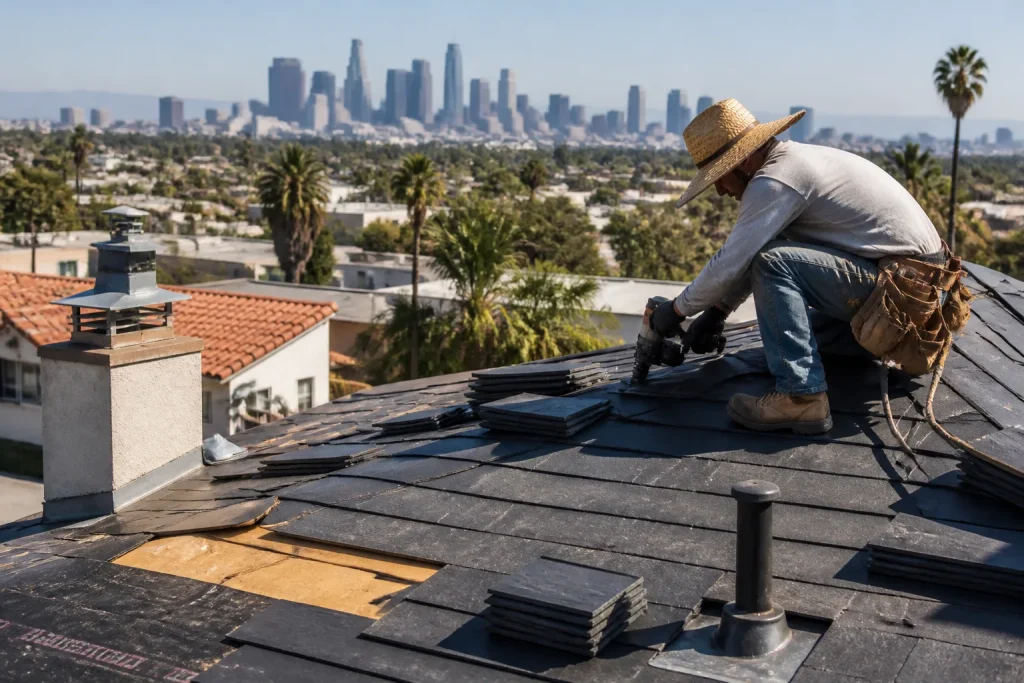
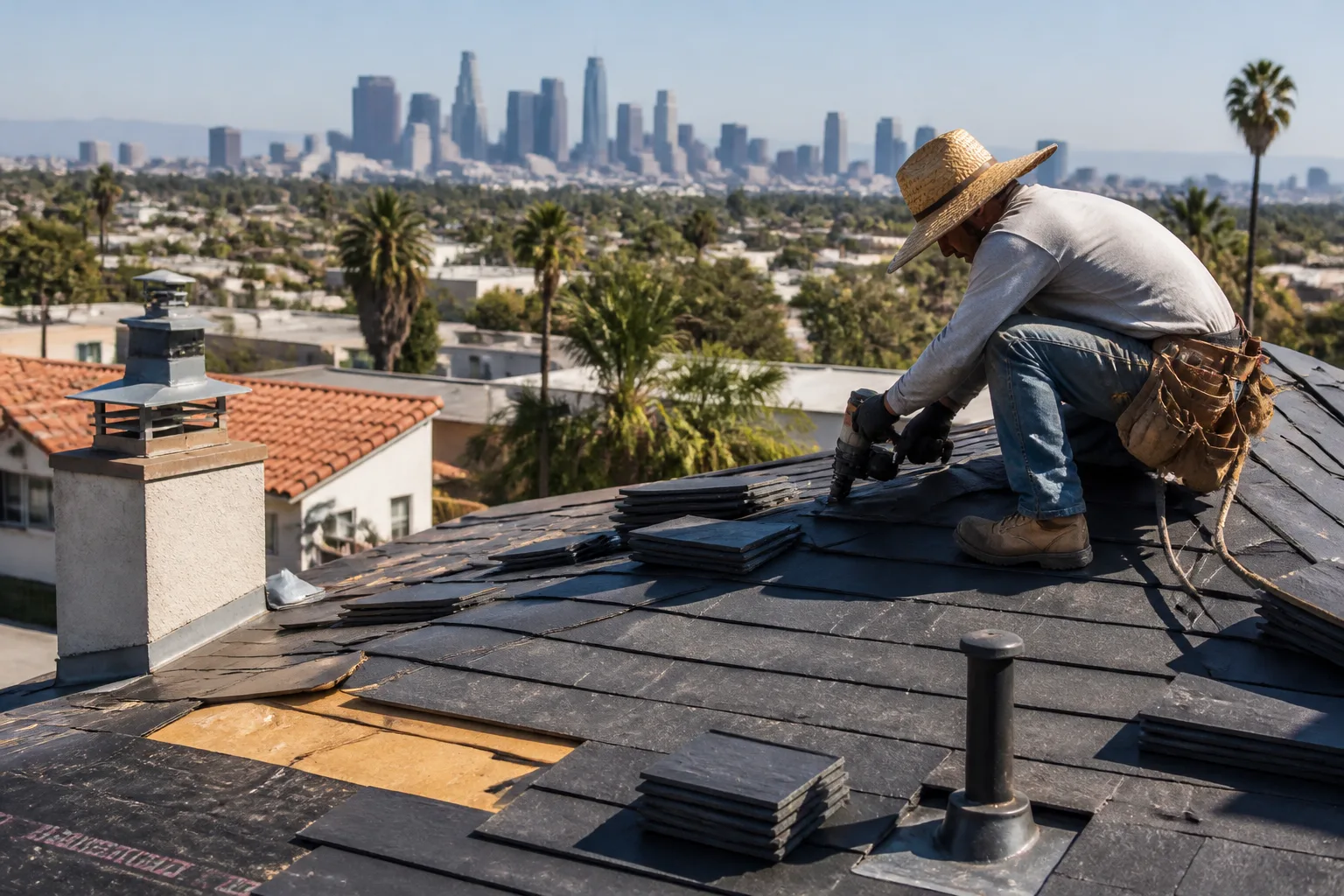
5 Mistakes to Avoid With Roof Installation
A roof installation done wrong in Los Angeles can cut your new roof’s life in half and void your warranty before the first Santa Ana wind season. The five critical errors almost always happen before the shingles go on: skipping the starter strip, using the wrong nailing pattern, ignoring attic ventilation math, taking flashing shortcuts, and signing vague contracts. If you’re planning a new roof and want a crew that documents every step with photos and puts every price in writing before work starts, call Crestview Roofing at (325) 246-5075 for a free estimate.
Roughly 80% of premature roof failures investigated by manufacturers trace back to installation error, not product defect. The shingles get blamed. The installer already has your money. We’ve spent 25 years in Los Angeles fixing roofs that failed too young, and the pattern is always the same: five decisions made in a hurry, invisible to the homeowner until the leak shows up.
1. Skipping the Starter Strip on Eaves
The starter strip is a 6-inch-wide row of shingle material installed along the eaves before the first full shingle course. It costs almost nothing. It prevents the single most common blow-off failure we see after LA wind events.
Without it, the adhesive seal on your first row of shingles has nothing to bond to. The tabs lift in wind, the seal breaks, and you get a ragged line of missing shingles along the entire edge of the roof. We’ve repaired this exact failure in neighborhoods from Sherman Oaks to Long Beach after every big Santa Ana event.
How to verify your crew used one:
- Ask for a photo of the eaves before shingles go on. You should see a solid black (or matching) strip with no tabs or cutouts.
- Check your contract specifies “starter strip at all eaves and rakes,” not just “starter course” which some crews interpret as a flipped regular shingle.
- After the job, look at the roof edge. A proper starter strip creates a clean, straight line with no shingle cutouts visible.
GAF, Atlas, and Tamko all require starter strips for their wind warranties. Skip this step and your 130-mph wind rating means nothing.
2. Using the Wrong Nailing Pattern
Los Angeles County code requires a 6-nail high-wind pattern for any roof in a wind-borne debris region, which covers most of the basin. Yet we regularly tear off roofs where the crew used 4 nails per shingle, the standard pattern for calm climates.
The difference matters. Four nails sit in a straight line across the shingle. Six nails create two staggered rows, locking the shingle to the deck across more surface area. In a 70-mph gust, that extra holding power is the difference between intact shingles and blue tarps.
How to spot the difference in a post-job photo:
- Ask your contractor for a close-up of a shingle still in the bundle, showing the nail placement diagram.
- Request a mid-installation photo of a shingle on the roof with nails visible before the next course covers them.
- Count: 6-nail pattern has two nails near each end and two in the middle, staggered. 4-nail pattern has one near each end and two centered.
At Roof Installation in Los Angeles, we photograph the nailing pattern on every job and include it in your digital documentation. You shouldn’t have to trust a verbal promise on something this basic.
3. Ignoring Attic Ventilation Math
This is the mistake that literally cooks your shingles from underneath. New shingles installed over an under-ventilated attic can see deck temperatures 40-60 degrees hotter than the outdoor air. That heat radiates upward, accelerates asphalt oxidation, and halves the rated lifespan of even premium materials.
Ventilation math is simple but rarely done. The FHA standard calls for 1 square foot of net free vent area for every 300 square feet of attic floor space, with intake and exhaust balanced. Most Los Angeles homes built before 1985 fall short, and many contractors never check.
What to ask before your install:
- Did you measure my attic floor space and calculate required vent area?
- Are my existing soffit vents clear, or blocked by insulation?
- Will you add ridge vent, box vents, or powered vents to meet code minimums?
- What deck temperature do you expect at peak summer heat?
We’ve replaced 12-year-old Atlas shingles that should have lasted 25. The shingles weren’t defective. The attic was 165 degrees in August and baked them brittle.
4. Flashing Shortcuts Around Chimneys and Skylights
Flashing is the metal that seals joints where the roof meets vertical surfaces: chimneys, skylights, walls. There are two types, and most leaks happen where they overlap.
Step flashing is L-shaped metal woven into each shingle course where a wall or chimney meets the roof slope. Counter flashing is the cap that covers the top edge of step flashing, either cut into masonry or surface-mounted. You need both, properly lapped, or water runs behind the metal and into your framing.
The shortcut we see constantly in Los Angeles: a single strip of surface-mounted metal caulked at the edges, with no step flashing underneath. It looks fine from the ground. It fails in the first heavy rain when the caulk cracks.
What to demand:
- Photos of the step flashing installation before shingles cover it. Once it’s buried, you’ll never know if it’s there.
- Counter flashing cut into mortar joints, not just glued to brick with sealant.
- Specific material: 26-gauge galvanized minimum, or copper if you want 50-year performance.
When to call a pro: If your chimney or skylight is leaking and you can’t see obvious damage from the ground, the problem is almost certainly flashing detail you can’t inspect without being on the roof. Call Crestview Roofing at (325) 246-5075. We document flashing work with before-and-after photos as part of Crestview Roofing home standards.
5. Signing a Vague Contract
The phrase “per manufacturer specs” sounds official. It means nothing is actually enforceable.
Every major brand, GAF, CertainTeed, Owens Corning, publishes detailed installation instructions: specific nail placement, overlap dimensions, ventilation requirements, acceptable underlayment types. A contract that says “installed per manufacturer specs” without naming which manufacturer and which spec document gives your contractor unlimited wiggle room.
Your contract should specify:
- Exact shingle brand and product line, e.g., “GAF Timberline HDZ” not just “GAF shingles”
- Specific installation document: “installed per GAF Application Instructions for Timberline HDZ, current edition”
- Nailing pattern: “6-nail high-wind pattern per LA County code”
- Starter strip brand and placement
- Underlayment type and layer count
- Flashing material, gauge, and installation method
- Ventilation calculation and product
At Crestview Roofing, our written price includes every material spec and installation standard before any work starts. The number on the page is the number on the invoice. That’s The Relay Visibility Guarantee, and it’s how we’ve operated since 2000.
Related services in Los Angeles: If you’re not sure whether you need full replacement or targeted repair, start with our Roof Repair in Los Angeles page to understand what’s fixable and what isn’t.
The Bottom Line
Most roof installation failures in Los Angeles aren’t dramatic. They’re slow, expensive, and preventable. The starter strip you didn’t know to check. The nail pattern hidden under granules. The attic heat that voids your warranty. The flashing buried under shingles before you could verify it. The contract language that lets a bad installer walk away clean.
Key takeaways:
- Verify the starter strip visually before shingles cover it
- Insist on 6-nail high-wind pattern and photo proof
- Demand ventilation calculations, not assumptions
- Request flashing photos before they’re covered
- Get manufacturer names and spec documents in writing
If you’re in Los Angeles and want a roof installed with every step documented, every price locked in writing, and a 365-Day Done Right Promise that covers every repair for a full year, call Crestview Roofing at (325) 246-5075. We’ll give you a written estimate with no pressure and no surprises.
Frequently Asked Questions
Most standard asphalt shingle roof installations in Los Angeles run $8,500 – $18,000 depending on roof size, pitch, and material choice. Premium architectural shingles from GAF or Atlas push toward the higher end; basic three-tab products fall lower. Steep pitches, multiple skylights, or deck damage requiring plywood replacement add to the total. Call (325) 246-5075 for an exact quote – estimates are free.
It shouldn’t, if your contractor did their job during estimation. At Crestview Roofing, the written price you receive before work starts is the price on your invoice – no change orders, no surprises. The only exception is hidden damage that couldn’t be reasonably detected during inspection, and even then we photograph it, explain it, and get your approval before proceeding. Call (325) 246-5075 for a fixed-price estimate.
Most single-family homes in Los Angeles take 1 – 3 days for complete tear-off and replacement, weather permitting. Larger homes, complex rooflines with multiple valleys, or tile-to-shingle conversions can extend to 4 – 5 days. We provide a specific day-by-day schedule in writing before work begins, with live trackable arrival times for our crew. Call (325) 246-5075 to schedule your project timeline.
Yes. Every full roof replacement in Los Angeles requires a building permit, and most jurisdictions also require a final inspection. Crestview Roofing pulls permits, schedules inspections, and passes them as part of our standard process. We include permit costs in your written estimate so there’s no surprise fee at the end. Call (325) 246-5075 and we’ll confirm the specific requirements for your city.
Written by Dylan Pace, Owner at Crestview Roofing, serving Los Angeles since 2000.
Need Roofing Help?
Call Crestview Roofing - licensed & insured, here with fast after-hours help in Los Angeles.
(325) 246-5075