
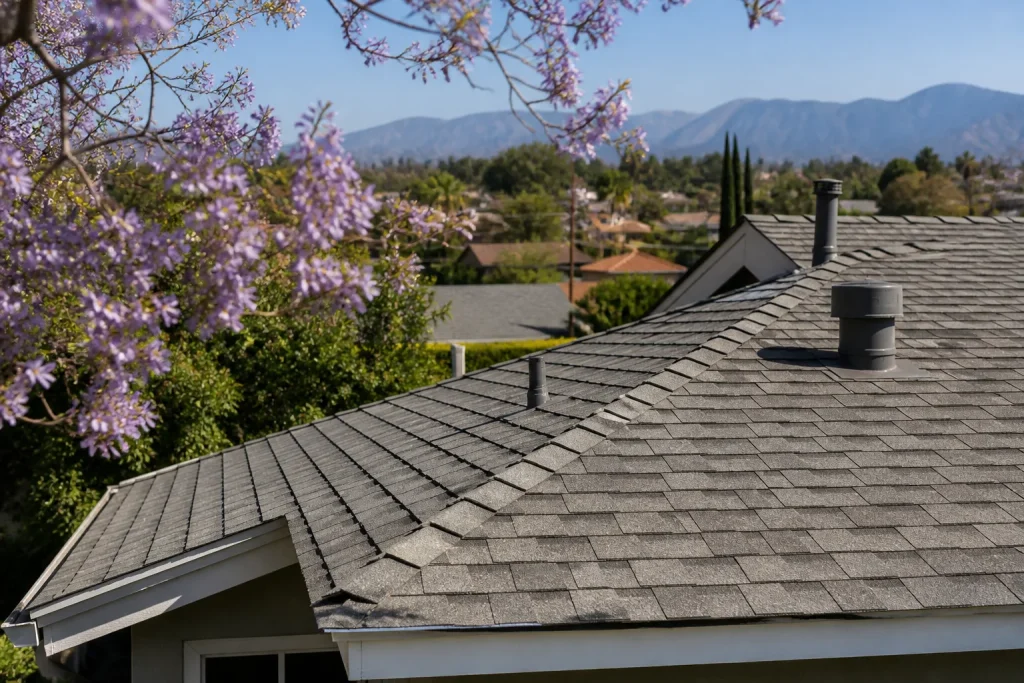
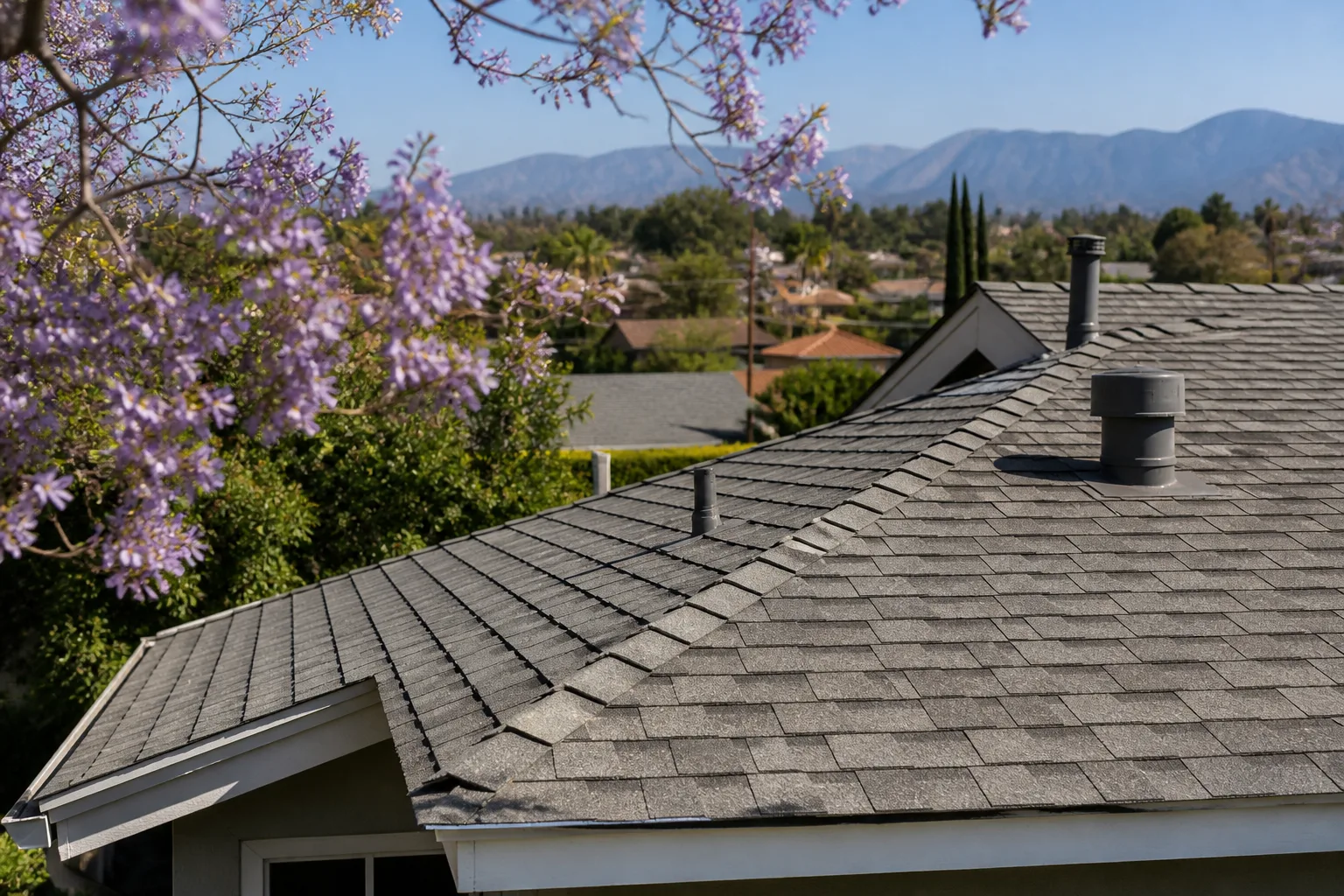
Spring Roofing Checklist for Los Angeles Homes
A spring roof inspection in Los Angeles should focus on five specific post-winter failure signatures: lifted ridge caps from Santa Ana wind cycles, cracked mortar on tile hips, darkened underlayment at valleys, granule accumulation in gutters, and attic humidity lines that signal active leaks before ceiling stains appear. Catching these between March and May prevents the June heat from baking minor damage into major repairs. If you’d rather have a trained eye handle it, call us at (325) 246-5075 and we’ll schedule a free estimate with written pricing before any work starts.
By April, most Los Angeles homeowners have no idea whether their roof took damage over winter because the damage is invisible from the street and the ceiling isn’t wet yet. That 90-day window between “not wet” and “visibly leaking” is when a $400 repair becomes a $4,000 one. We’ve seen it repeatedly – a small valley underlayment tear in March turns into saturated decking by August because the homeowner waited for a stain to appear.
The Five Post-Winter Failure Signatures Specific to LA Roofs
Los Angeles roofs don’t fail the way Midwest roofs fail. Our wet season is short but intense, and Santa Ana winds create cyclic lifting that loosens components gradually. Here’s what we look for every spring:
- Lifted ridge caps: Wind gets under the caps that sit along your roof’s peak and works the adhesive loose. From the ground they look fine. Up close, you’ll see a hairline gap or lifted edge that lets water run directly onto the ridge beam. We check these by hand – if a cap moves, it needs re-adhesion or replacement.
- Cracked mortar on tile hips: Clay and concrete tile roofs in Los Angeles rely on mortar bedding at hip and ridge junctions. One winter of thermal cycling (cold rain, then dry heat) creates hairline cracks that widen fast. Tap the mortar gently; a hollow sound means it’s separating from the tile.
- Darkened underlayment at valleys: Valleys channel the most water. If you can safely view them from a ladder, look for any darkening or waviness in the visible underlayment – that’s moisture absorption, not shadow. On composition shingle roofs, this often precedes visible interior damage by two to three months.
- Granule accumulation in gutters: Some granule loss is normal. But if your downspout elbows are packed with grit after winter rains, your shingles are shedding the protective layer that blocks UV. In Los Angeles, where summer UV index regularly hits 10+, accelerated granule loss means premature failure.
- Attic humidity lines: These show up as faint water marks on rafters or sheathing, usually at nail penetrations or around vents. They dry quickly in our climate, so they’re easy to miss – but they prove water is getting in during storms.
We caught all five on a single inspection in the Hollywood Hills last April. The homeowner had no interior leaks. By June, without repair, two of those five would have been active leak points.
How to Inspect Your Attic 24 Hours After Rain
This is the single most useful thing a Los Angeles homeowner can do, and almost nobody does it. Wait for any spring rain to pass, then enter your attic with a flashlight after 24 hours – not immediately, when water is still moving, and not a week later, when it’s dried.
Here’s exactly what to look for and where:
- Start at the ridge: Follow the peak beam with your flashlight beam parallel to the wood surface, not straight at it. Water tracks show as slightly darkened, slightly raised lines running down from penetrations.
- Check nail pops in sheathing: Every nail through your roof deck is a potential entry point. Look for rusty nail heads or halos of darkened wood around them. In Los Angeles, these often appear on north-facing roof slopes where moisture lingers longest.
- Inspect around vent pipes and chimneys: Follow the framing members that connect to these penetrations. Water travels along wood before it drips onto insulation, so the leak point and the visible mark can be four to six feet apart.
- Look at insulation directly below valleys: Press your hand gently into batt insulation. If it feels dense or cool compared to surrounding areas, it’s absorbed moisture that hasn’t dried.
- Check for daylight: Any visible light through the roof deck means an opening. Even pinholes admit surprising water volume during our winter downpours.
We pulled a repair in Los Feliz last spring where the homeowner found a humidity line during exactly this check. The repair was $380. Their neighbor, same street, same roof age, waited for the ceiling stain – $3,200 for decking, insulation, and interior paint.
Why Spring Is the Right Time for Wood Rot and Decking Repair
Los Angeles has a narrow window for decking work. Exposed roof decking – the plywood or OSB beneath your shingles or tile – needs to be dry but not desiccated when repairs are made.
Here’s the problem: June through September, attic temperatures in Los Angeles regularly exceed 140°F. Wood that was slightly compromised in winter dries rapidly, checks (develops surface cracks), and expands the damaged area. What was a two-square-foot soft spot in March becomes a six-square-foot replacement in August because the surrounding wood degraded.
Spring repairs also let us use manufacturer-specified adhesives and sealants that cure properly in moderate temperatures. Some self-adhering underlayments won’t bond correctly above 90°F ambient, which means summer installs in Los Angeles require modified technique or additional fasteners. Spring is simpler, more reliable, and the materials perform as designed.
If your inspection reveals any spongy decking, discolored plywood, or separated layers at the edges, schedule repair before Memorial Day. The cost difference between March and August for the same underlying issue is typically 40 – 60% higher in summer due to expanded damage area and more complex material handling.
Flat Roof Checklist: Parapets, Drains, and Debris Protocols
Flat or low-slope roofs are common on Los Angeles additions, ADUs, and mid-century homes, and they fail differently than pitched roofs. If your home has any flat roof area, use this separate inspection protocol:
- Parapet walls: Check the coping metal (the cap on top of the parapet) for separation or missing fasteners. Wind lift here tears the membrane at the most vulnerable point – the vertical-to-horizontal transition. Look for cracked or missing sealant at corners.
- Scuppers and drains: Remove all debris by hand. Don’t use a hose – you’ll push leaves into the drain line. In Los Angeles, spring inspections routinely find scupper openings reduced 70% by accumulated leaves and dust that winter rains packed into mud. A blocked scupper during a spring storm causes immediate ponding and structural load issues.
- Membrane seams: Walk the roof slowly and look for seam ridges, bubbles, or areas where the membrane has pulled from the edge metal. Our Santa Ana winds create uplift that works seams loose over multiple seasons, not one dramatic event.
- Ponding water marks: Even if no water is present, look for darkened areas with debris rings – these indicate chronic ponding that degrades the membrane. Los Angeles building code allows 48-hour ponding; if you see evidence of longer standing water, the slope or drain is compromised.
- HVAC platforms and penetrations: These are the most common leak points on flat roofs. Check the flashing boots and sealant around every pipe, conduit, and unit curb. Vibration from compressors accelerates sealant failure.
We use Boral and CertainTeed materials for flat roof repairs where appropriate, matched to the existing system. Mixing membrane types without compatibility verification causes premature failure – a shortcut we won’t take.
What a Legitimate Spring Inspection Report Should Include
Los Angeles homeowners are flooded with “free 37-point inspections” that are really sales presentations. Here’s how to tell the difference between a legitimate assessment and a replacement pitch in disguise:
| Legitimate Inspection | Sales Pitch |
|---|---|
| Photos of every finding, with your roof specifically identified | Generic stock photos or no photos |
| Written findings with locations noted (e.g., “south valley, 8 feet from ridge”) | Verbal summary only, or checklist with checkmarks |
| Repair recommendations with line-item written pricing | Single replacement quote presented same-day |
| No-pressure timeline – “address this season” or “monitor annually” | Urgency language – “your roof is failing” without specific evidence |
| Options presented: repair, monitor, or replace with clear triggers for each | Replacement presented as only option |
At Crestview Roofing, every spring inspection in Los Angeles follows The Relay Visibility Guarantee: written price before any work begins, before-and-after photo documentation, a live trackable arrival time, and a digital invoice sent by text. The 365-Day Done Right Promise covers every repair for a full year, including a free second visit if the repair fails. No surprises, no arguments, no voicemail loops.
When to Call a Pro
If your attic inspection reveals any active moisture, if you can’t safely access your roof or attic, or if you find any of the five failure signatures we described, call for a professional assessment. Roof work involves height, slope, and structural judgment that isn’t worth risking for a YouTube tutorial.
Related services in Los Angeles: Roof Repair in Los Angeles, Roof Replacement in Los Angeles, and Roof Installation in Los Angeles.
The Bottom Line
Spring in Los Angeles is a 90-day diagnostic window. The damage winter left behind is present but not yet expensive. Caught now, most issues are straightforward repairs. Ignored until summer heat accelerates deterioration, the same problems require decking replacement, interior repair, and disrupted schedules.
Our recommendation: do the attic check after the next rain. Walk the perimeter with binoculars. Check your gutters for granules. If anything concerns you, or if you’d rather have trained eyes on it from the start, call Crestview Roofing at (325) 246-5075. We’ll schedule a free estimate, show up at a trackable arrival time, and give you written pricing before any work starts. That’s The Relay Visibility Guarantee, and it’s how we’ve worked in Los Angeles since 2000.
Frequently Asked Questions
Most reputable roofers in Los Angeles charge $150 – $300 for a comprehensive inspection with written findings and photos. At Crestview Roofing, we apply that inspection fee toward any repair work you choose to proceed with. Call (325) 246-5075 to schedule – estimates are free, and inspections come with written pricing if work is needed.
Inspect your roof twice yearly: once in spring after the rainy season ends, and once in fall before it begins. Los Angeles homes also need inspection after any significant Santa Ana wind event, which can lift or dislodge components without leaving visible ground-level evidence. The spring inspection is the more critical of the two, as it catches winter damage before summer heat amplifies it.
Homeowners can safely handle attic inspections and ground-level perimeter checks with binoculars. We don’t recommend walking your roof unless you have proper fall protection and experience on sloped surfaces. For the five failure signatures we described – especially lifted ridge caps and valley underlayment – a professional with roofing-specific footwear and anchor knowledge will spot issues you’d miss and assess them without causing additional damage. If you’re unsure, call (325) 246-5075 for a free estimate.
Mark the location, photograph it, and schedule repair promptly. In Los Angeles, intermittent leaks are common – water enters during specific wind-driven rain conditions, then dries completely between events. Waiting for “the next rain to confirm it” allows ongoing damage to sheathing, insulation, and framing. A professional can trace the entry point using moisture meters and infrared imaging even in dry conditions. Call (325) 246-5075 and we’ll locate it and give you written pricing before any work begins.
Written by Dylan Pace, Owner at Crestview Roofing, serving Los Angeles since 2000.
Need Roofing Help?
Call Crestview Roofing - licensed & insured, here with fast after-hours help in Los Angeles.
(325) 246-5075