
Preparing Your Home’s Roofing for Winter in Los Angeles
Preparing your roof for winter in Los Angeles means clearing nine months of accumulated debris from drainage paths and checking ridge caps and flashing before Santa Ana winds arrive, not installing heat cables or worrying about ice dams. Most LA homeowners who call us in November with an active leak skipped these two steps in October. If you’d rather have a pro handle it, call us at (325) 246-5075 for a free estimate with a written price before any work starts.
Los Angeles averages only 15 inches of rain per year, but roughly 60% of it drops in just three months. A roof that seemed fine all summer has nine months of dust, debris, and thermal expansion working against it. The first November storm is the stress test, and it catches people off guard every single year.
Why LA Winter Prep Is Different From Everywhere Else
National roofing checklists will tell you to check for ice dams, inspect attic insulation for frost buildup, and look for icicle damage. None of that applies here. Los Angeles winter prep is about drainage speed and wind resistance, not cold-weather protection.
Our clay tile and concrete roofs, especially in neighborhoods like Pasadena and the Hollywood Hills, collect dust from March through October that hardens into a film. When that first heavy rain hits, water sheets off unevenly instead of channeling into gutters. Meanwhile, Santa Ana winds in October and November, often gusting past 60 mph, test every ridge cap and piece of flashing that loosened during summer’s thermal cycling.
We pulled a job in Silver Lake last November where the homeowner had followed a generic online checklist from a Minnesota roofing blog. They’d added attic insulation and checked for “frost pockets.” Their actual problem was a downspout elbow packed with jacaranda pods that backed water into the fascia. The repair was $340. The insulation did nothing.
Focus your prep on what actually fails in Los Angeles: clogged drainage, wind-lifted components, and the flat-to-slope transitions where water pools.
The Three Drainage Points That Cause 80% of Interior Damage
Most water damage we see in Los Angeles after the first fall rains traces back to three specific spots. Clear and inspect these, and you’ve eliminated the majority of your risk.
- Gutters: Not just “clean the gutters.” Check the slope. LA’s summer heat warps gutter hangers, creating low spots where water sits. A gutter that holds water breeds mosquitoes in summer and overflows in winter. Look for standing water 48 hours after a rare summer rain, or pour a bucket in and watch how it drains.
- Downspouts: Remove the bottom elbows and check for compacted debris. Palm frond fibers, in particular, form dense mats that tools can’t reach. We use a plumber’s snake on stubborn clogs. Make sure downspouts discharge at least six feet from the foundation, or better, into a drain line.
- Flat-to-slope transitions: These are the valleys and crickets where a flat section meets a pitched roof, common on Los Angeles additions and garage conversions. Debris collects at the seam, and the membrane or metal flashing at this joint is already the weakest point on the roof. Clear it by hand, then run water from a hose for five minutes to confirm it drains.
If any of these three points overflows during your test, you’ve found your priority. Don’t wait for the first storm to prove it.
The 20-Minute Santa Ana Wind Pre-Check
Santa Ana winds hit hardest in October and November, just before the rains arrive. A 20-minute inspection of your roof’s edge details can prevent a mid-storm emergency call.
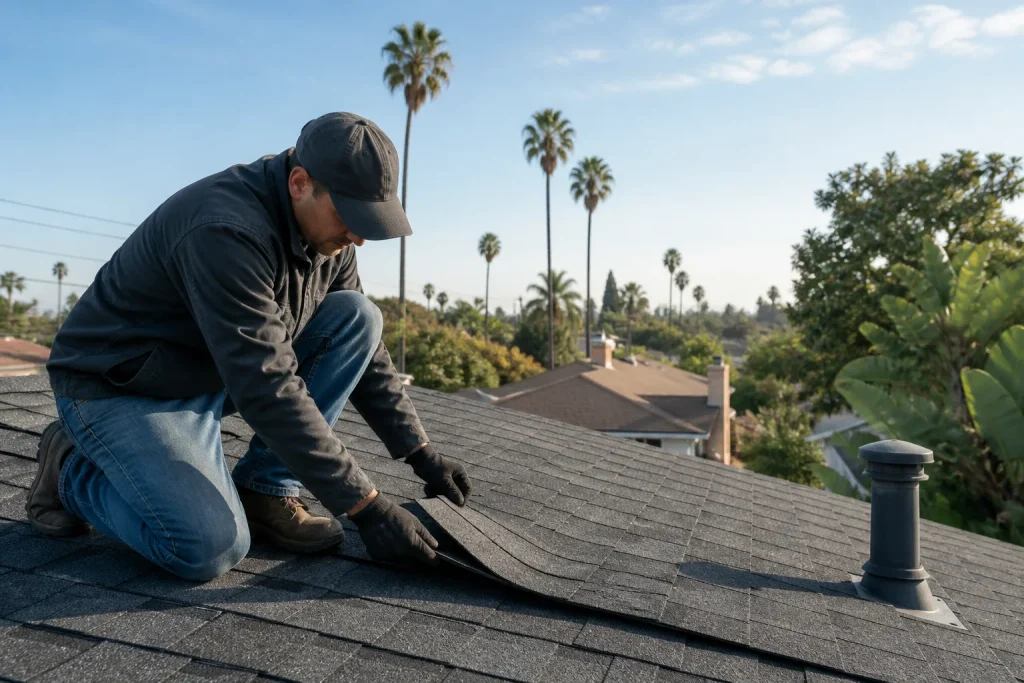
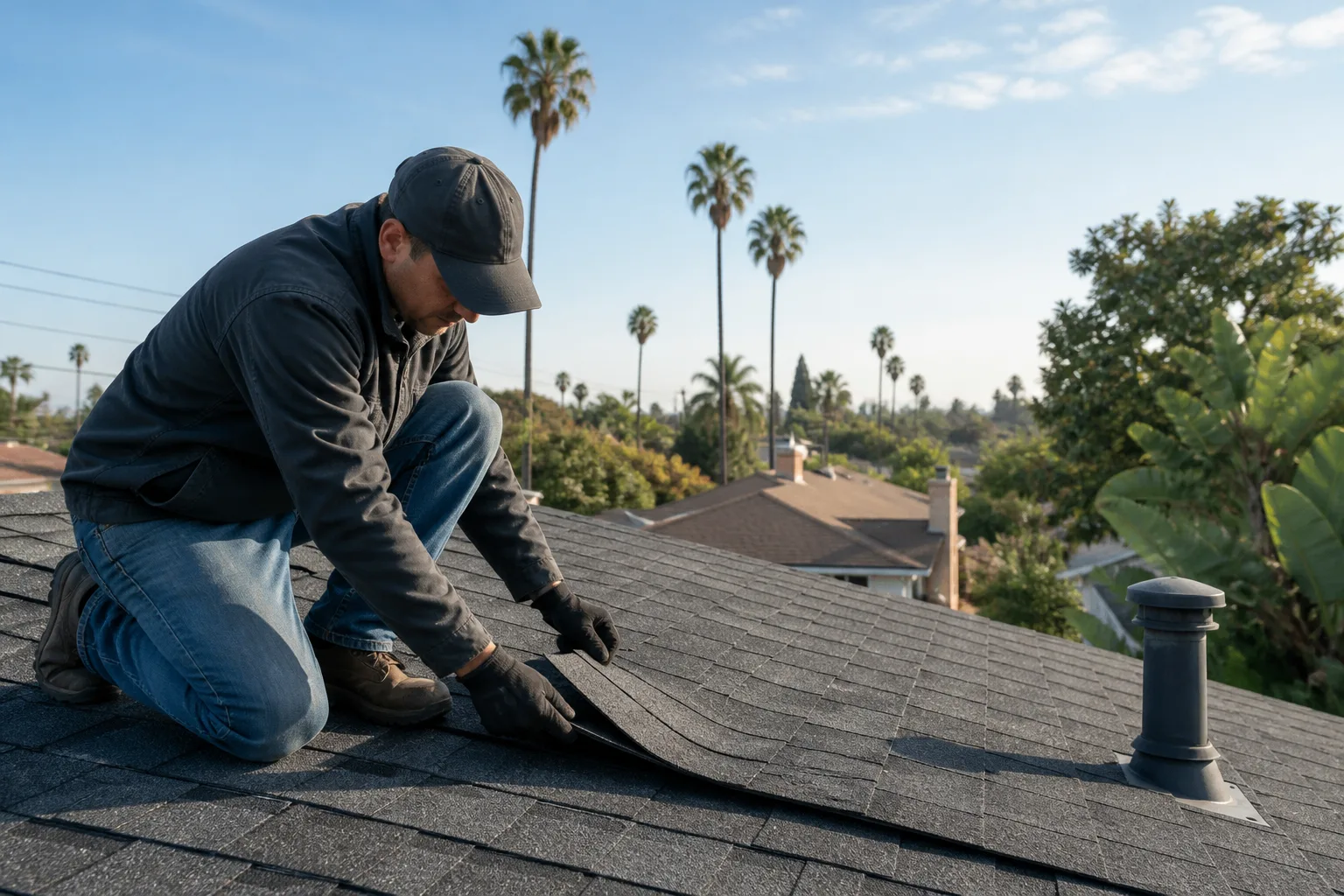
Start with the ridge caps, the tiles or shingles that cover the peak where two roof planes meet. These catch wind from both directions. In our experience across Los Angeles, from the Valley to the Westside, ridge caps are the first component to lift because they’re exposed and often secured with less fastening than field shingles. Look for cracked mortar on clay tile caps, or lifted tabs on composition shingles. Tap gently. A solid cap doesn’t move.
Next, check the flashing, the metal strips that seal joints around chimneys, vents, and wall intersections. Wind gets underneath loose flashing and peels it back like a sardine can lid. Focus on the windward side of the house, typically northeast during Santa Ana events. If you see gaps, lifted edges, or missing fasteners, that’s your repair list.
Finally, walk the perimeter and look for any debris accumulation against the roof edge. A pile of leaves or a stray tarp creates turbulence that increases local wind pressure. Remove it.
This inspection is visual only. Don’t climb on the roof if you’re not comfortable, and never step on clay tile without proper weight distribution. Roof work at height carries real fall risk. If you’re unsure what you’re seeing, call a professional.
How to Document Your Roof Before the First Storm
Insurance claims filed in January go smoother with a clear baseline from October. Here’s how to build one that actually helps.
Take dated photos of all four roof elevations from the ground, using a phone with location services on. Capture the gutters, downspouts, and any visible flashing. Then take close-ups of specific conditions: a slightly lifted shingle tab, a minor crack in a tile, the current state of your flat-to-slope transitions. These aren’t problems yet. They’re your “before” record.
Store these in cloud backup, not just on your phone. If a January storm causes damage that your insurer disputes as “pre-existing,” you have timestamped, geotagged evidence of the roof’s condition.
At Crestview Roofing, we include before-and-after photo documentation with every job as part of The Relay Visibility Guarantee. If we perform your pre-winter inspection, those photos are yours to keep for insurance purposes.
What a Pre-Winter Inspection Should Cost in Los Angeles
Most standard pre-winter roof inspections and minor tune-ups in Los Angeles run $150 – $350. That should include gutter clearing, debris removal from valleys and transitions, a written condition report with photos, and minor repairs like resealing a vent or replacing a few wind-damaged shingles.
Be wary of any roofer who quotes a full repair on the spot without documentation. A proper inspection takes time. At our company, we deliver a written price before any work starts, and if the inspection reveals only maintenance needs, that’s what we quote. We’ve seen competitors in Los Angeles use the October rush to upsell unnecessary full replacements on roofs with 10+ years of life left.
What we do during a pre-winter visit:
- Clear all drainage paths and test flow
- Inspect ridge caps, flashing, and field shingles or tiles
- Check attic ventilation for blockages that trap moisture
- Document condition with before photos
- Provide a written, itemized quote for any recommended repairs
The number on that quote is the number on the invoice. That’s The Relay Visibility Guarantee.
When to Call a Pro
Call a roofer if you find lifted or missing shingles, cracked tiles, damaged flashing, or any drainage point you can’t clear yourself. Also call if your roof is over 20 years old and hasn’t been inspected in two or more years. In Los Angeles, the combination of UV exposure, thermal cycling, and occasional seismic movement ages materials differently than in milder climates.
Related services in Los Angeles: Roof Repair in Los Angeles, Roof Replacement in Los Angeles, and Roof Installation in Los Angeles.
Key Takeaways
- LA winter prep targets drainage and wind, not ice or cold
- Clear gutters, downspouts, and flat-to-slope transitions first
- Inspect ridge caps and flashing before Santa Ana winds arrive
- Document roof condition with dated, geotagged photos for insurance
- Expect to pay $150 – $350 for a proper inspection and tune-up
- Get any repair quote in writing before work begins
The Bottom Line
The roof that handled last winter fine may not handle this one. Nine months of Los Angeles sun and dust change the equation. Spend a Saturday in October on drainage and a 20-minute wind check, or have a pro do it. Either way, the first November storm should be a confirmation that your prep worked, not the moment you discover a problem.
If you’re in Los Angeles and want a pre-winter inspection with a written price before any work starts, before-and-after photos, and a live trackable arrival time, call Crestview Roofing at (325) 246-5075. Estimates are free, and a live person answers 24/7.
Frequently Asked Questions
Most pre-winter inspections and minor tune-ups in Los Angeles cost between $150 and $350. That typically covers gutter clearing, debris removal, a written condition report with photos, and small repairs like resealing vents or replacing a few damaged shingles. Call (325) 246-5075 for an exact quote on your home, estimates are free.
Yes, but it’s different from cold-climate prep. Los Angeles roofs face concentrated rainfall, Santa Ana winds, and accumulated debris rather than snow or ice. The first heavy rain after a dry summer is when most leaks appear, because dust and debris have blocked drainage paths and thermal cycling has loosened components.
Ground-level visual checks and gutter clearing are reasonable DIY tasks. However, walking on a roof, especially clay tile or steep pitches, carries fall and breakage risk. We recommend professional inspection if your roof is over 20 years old, if you spot damaged flashing or lifted materials, or if you’re not comfortable at height. Call (325) 246-5075 to schedule a free estimate.
At Crestview Roofing, the written price we provide before work begins is the price on the invoice, period. No change orders, no surprises. That’s The Relay Visibility Guarantee. If a roofer won’t put a fixed price in writing, that’s a signal to get another quote. Call (325) 246-5075 for a written estimate.
Written by Dylan Pace, Owner at Crestview Roofing, serving Los Angeles since 2000.
Need Roofing Help?
Call Crestview Roofing - licensed & insured, here with fast after-hours help in Los Angeles.
(325) 246-5075