
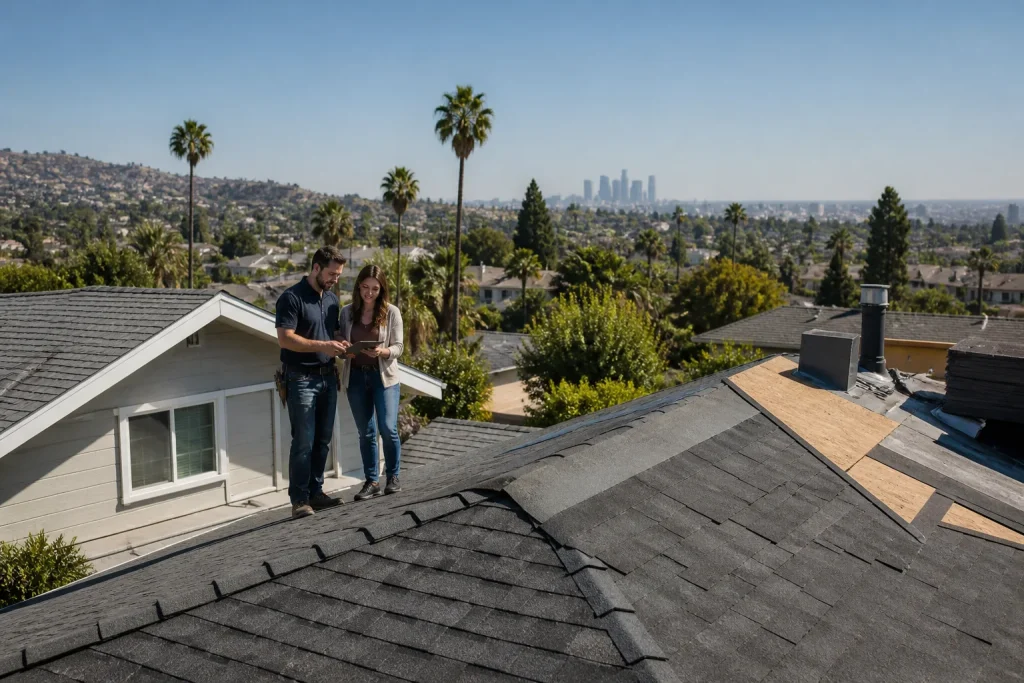
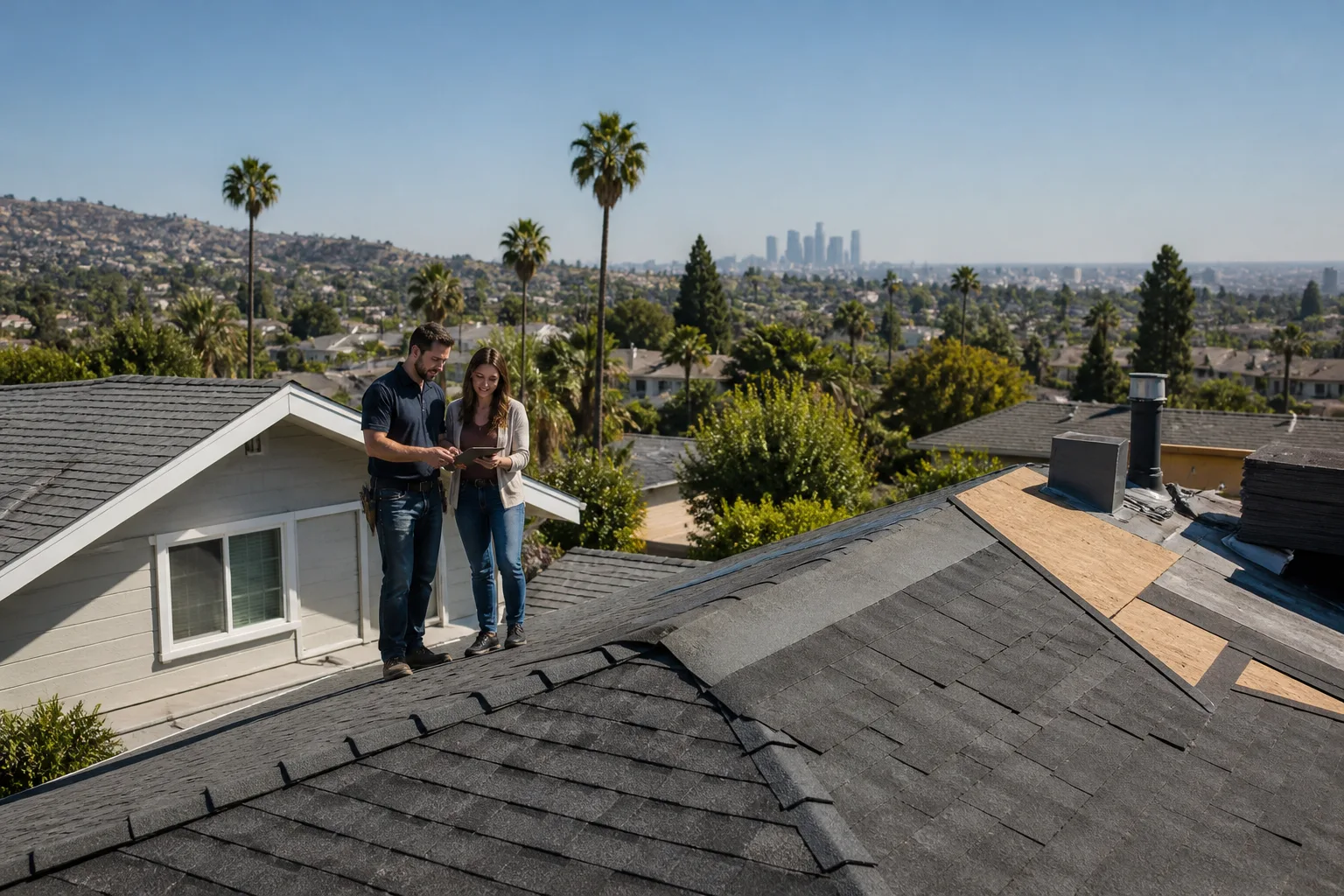
Roof Installation: Repair or Replace? How Los Angeles Homeowners Decide
Most Los Angeles homeowners should repair their roof when the decking beneath is solid and replace it when that decking is compromised. The catch: you can’t see the decking from the street, and many roofers won’t check it until they’ve already torn everything off. In our experience, the repair-vs-replace decision in Los Angeles comes down to three attic inspections you can do yourself in about 15 minutes.
If you’d rather have a pro assess it, call us at (325) 246-5075. We’ll check the decking, give you a written price before any work starts, and let you make the call with real information.
Why the Decking Matters More Than the Shingles
Here’s what most roofers in Los Angeles won’t say upfront: shingles are a wear layer, not the structure. The OSB or plywood decking underneath is what actually keeps water out of your living room. We’ve seen 12-year-old shingle roofs in Venice with perfect decking that needed only spot repairs, and 18-year-old roofs in Eagle Rock where the decking was so rotted that patching would have been throwing money away.
The problem is that repair quotes are based on what a roofer can see from a ladder. They’ll count missing shingles, note cracked tiles, spot lifted flashing – the metal strips that seal joints around chimneys and vents – but they can’t assess the decking without getting into the attic or pulling up a section of roof. By the time they do that, you’re already committed.
That’s why we built our estimates around a decking-first assessment. Before we quote repair or replacement on any Los Angeles home, we check three things from inside the attic. You can do this yourself before you call anyone.
The Three-Point Attic Inspection Homeowners Can Do First
Bring a flashlight and a screwdriver to your attic access. Walk the joist lines carefully, and look for these three warning signs:
- Soft spots: Press the screwdriver gently into the decking between joists. Solid plywood or OSB resists. If the blade sinks in easily, that section is moisture-compromised and will need replacement regardless of what the shingles look like.
- Staining rings: Look for concentric brown or yellow circles, especially near valleys, chimneys, and vent penetrations. A single small stain might mean a one-time leak. Multiple overlapping rings mean chronic moisture intrusion, and the decking’s integrity is suspect even if it still feels firm.
- Daylight gaps: Turn off your flashlight and look for pinholes or streaks of light. Any daylight coming through means the underlayment – the waterproof barrier beneath your shingles – has failed. In Los Angeles, where we get intense UV followed by occasional hard rain, this gap lets water in fast when it does storm.
If you find two or more of these issues across multiple areas, replacement is probably the smarter financial play. One isolated soft spot with otherwise clean decking? Repair is likely viable. The key is knowing before you get a quote, so you can ask the right questions.
How Los Angeles Climate Changes the Standard Rules
National roofing advice says asphalt shingles last 20 – 25 years and should be replaced around year 15. That timeline assumes a mix of rain, snow, freeze-thaw cycles, and moderate sun. Los Angeles doesn’t play by those rules.
Our climate profile is distinct: low annual rainfall, extremely high UV exposure, and periodic Santa Ana wind events that gust to 60+ mph. Here’s what that actually does to roofs:
- UV degradation is the hidden killer. Shingles in Los Angeles bake for 280+ days a year. The asphalt dries out, granules shed faster, and the material becomes brittle. A 20-year shingle here might look fine from the ground at year 18 while being structurally cooked.
- Rare rain events cause concentrated damage. When Los Angeles does get rain, it often comes in intense bursts after long dry spells. Water finds every crack, and the decking takes the hit because the homeowner hasn’t had regular leak signals to watch for.
- Santa Ana winds test attachment. We see more lifted shingles and torn flashing in the weeks after Santa Ana events, especially in hillside neighborhoods like Silver Lake and Mount Washington where wind channels.
This means a 22-year-old roof in Cleveland and a 22-year-old roof in Los Angeles are not comparable. We’ve replaced roofs in Los Angeles at 14 years that were genuinely done, and we’ve repaired roofs at 24 years where the decking was pristine and the shingles just needed targeted work. Age alone is a poor guide here.
The 50% Rule and Why Material Warranties Back It Up
There’s a straightforward cost heuristic in the roofing trade: when repair costs exceed 50% of full replacement cost, replacement is usually the better value. But there’s a less-discussed reason this rule exists.
Manufacturer warranties from brands like Owens Corning, IKO, and Atlas typically require that repairs be made to systems that meet current installation standards. If your existing roof has outdated underlayment, insufficient ventilation, or decking that doesn’t meet span ratings, a repair won’t carry the same warranty protection as a full replacement. You’re paying premium prices for uncovered work.
In practical Los Angeles terms: if you’ve got a 1,800 square foot bungalow and you’re looking at $8,500 in repairs versus $16,000 for full replacement, the math tilts toward replacement quickly. The repair buys you partial coverage with no warranty backing; the replacement gets you full system protection, often 25 – 50 years on materials, plus the ability to address ventilation and decking issues comprehensively.
We always lay this out in writing. Our quotes show repair cost, replacement cost, and the warranty status of each option. No homeowner should have to guess which choice protects their investment.
How to Get a Roofer to Commit to Decking Assessment in Writing
This is where many Los Angeles homeowners get stuck. They call three roofers, get three quotes, and none of them explicitly address the decking condition. Here’s what to ask, and what the answers mean:
- “Will you inspect the decking from the attic before quoting?” A roofer who says no, or who insists they can assess everything from the roof surface, is cutting corners. Polite pass.
- “If you find damaged decking during repair, how does pricing change?” Vague answers like “we’ll see when we get in there” are red flags. You want a written price per sheet for OSB or plywood replacement, established before work starts.
- “Will you document decking condition with photos?” This is standard for us – part of The Relay Visibility Guarantee – but surprisingly rare in the industry. Photos protect both parties and eliminate disputes about whether damage was pre-existing.
Any company that won’t put this in writing should be crossed off your list. The estimate isn’t real if it doesn’t account for the variable that determines whether repair was the right call in the first place.
At Crestview Roofing, every Los Angeles estimate includes attic decking photos, a written price for any likely decking replacement, and our live trackable arrival time so you know exactly when we’re arriving. The number on the page is the number on the invoice – no change orders because we “found something unexpected.”
Real Cost-Per-Year Math: A 1,800 Sq Ft LA Bungalow
Let’s make this concrete with actual numbers for a typical Los Angeles home. These are ranges we’ve seen in the market, not our specific pricing – every roof is different – but they’ll show you how to think about the decision.
| Scenario | Upfront Cost | Expected Lifespan | Cost Per Year |
|---|---|---|---|
| Targeted repair (solid decking) | $3,500 – $5,500 | 8 – 12 years | $290 – $690 |
| Major repair (partial decking replacement) | $7,500 – $10,500 | 10 – 14 years | $540 – $1,050 |
| Full replacement (new decking, premium shingles) | $15,000 – $22,000 | 25 – 35 years | $430 – $880 |
The surprise: on a per-year basis, full replacement often wins even when repair seems cheaper upfront. A $9,000 major repair that lasts 12 years costs $750 annually. A $18,000 replacement that lasts 30 years costs $600 annually – and comes with a material warranty, better energy efficiency, and no anxiety about the next leak.
The repair only makes financial sense when the decking is sound and the damage is genuinely isolated. That’s why the attic inspection comes first. Without it, you’re guessing with four figures on the line.
When to Call a Pro
If your attic inspection reveals multiple soft spots, widespread staining, or daylight gaps, it’s time for professional assessment. Same call if you’re unsure what you’re seeing – a 10-minute conversation beats a $10,000 mistake.
Related services in Los Angeles: Roof Repair in Los Angeles | Roof Replacement in Los Angeles | Roof Installation in Los Angeles
We pulled a roof in Los Feliz last month where the homeowner had gotten two repair quotes and was ready to pull the trigger. We did our standard attic check and found daylight gaps running the length of a valley – the underlayment had been deteriorating for years, invisible from outside. Full replacement was the only honest recommendation. He wasn’t thrilled about the higher number, but he was grateful not to have spent $6,000 on a repair that would have failed inside two years. That’s the whole point of checking first.
The Bottom Line
Repair or replace isn’t a shingle question. It’s a decking question, and in Los Angeles the climate accelerates hidden damage that standard inspections miss. Do the three-point attic check first. Apply the 50% rule with warranty context. Run the cost-per-year math. And only work with roofers who’ll assess the decking in writing before they quote.
Key takeaways:
- Decking condition, not shingle age, determines whether repair is viable
- Los Angeles UV and Santa Ana winds age roofs differently than national averages
- The 50% rule has warranty implications most roofers don’t explain
- Cost-per-year math often favors replacement even when repair seems cheaper upfront
- Written decking assessment before quoting separates pros from pretenders
If you’re in Los Angeles and want a decking-first assessment with a written price before any work starts, call Crestview Roofing at (325) 246-5075. We’ll check your attic, show you photos, and give you real numbers to make the decision with confidence.
Frequently Asked Questions
Most standard repairs in Los Angeles run $3,500 – $5,500 when the decking is solid, while full replacement on a typical home ranges from $15,000 – $22,000. The critical variable is whether partial or full decking replacement is needed, which can add $2,000 – $5,000 to either scenario. Call (325) 246-5075 for a written estimate on your specific roof – estimates are free.
Only if the decking passes the three-point inspection: no soft spots, no staining rings, and no daylight gaps. Shingle-only replacement over compromised decking traps moisture and accelerates rot. We see this shortcut frequently on Los Angeles homes, and it always costs more to fix later. A proper roofer will refuse to install new materials over damaged decking – if they’ll do it, that’s a red flag.
Most residential replacements on standard Los Angeles homes take 2 – 4 days, depending on decking condition, roof complexity, and weather. Santa Ana wind events can pause work for safety. At Crestview Roofing, we give you a live trackable arrival time and daily photo updates so you know exactly where the job stands. Call (325) 246-5075 to schedule your assessment.
Insurance typically covers sudden damage from wind, fallen trees, or fire – not gradual wear. In Los Angeles, we’ve seen claims approved for Santa Ana wind damage and denied for UV-related deterioration. We document everything with photos and written reports to support your claim if damage is sudden and covered. For wear-related replacement, financing options often make the annual cost comparable to what you’d pay in premiums anyway. Call (325) 246-5075 to discuss your situation.
Written by the team at Crestview Roofing.
Need Roofing Help?
Call Crestview Roofing - licensed & insured, here with fast after-hours help in Los Angeles.
(325) 246-5075